
|
Luis M. CARRASCAL ResearcherID
- ResearchGate
|
Main Scientific Papers [todas / all] - OrcID Atlas Virtual de las Aves Terrestres de España |

“The whole problem with the world is that fools and fanatics are always so certain of themselves, and wiser people so full of doubts” — Bertrand Russell
PRINCIPALES ACTIVIDADES PROFESIONALES: 2023, 2022, 2021, 2020, 2019, 2018, 2017
Key words for this web page:
Organisms: Vertebrate Ecology; Aves; Reptilia; Passeriformes; Passerines; Paridae; Parus; Pygoscelis; Tits; Penguins; Lacertids; Lizards; Psammodromus
Topics: Iberian Peninsula;
Canary Islands; Antarctica; Ornithology; Herpetology; Biogeography;
Zoogeography; Distribution; Density; Abundance; Community Ecology; Habitat
breadth; Niche width; Habitat selection and preferences; Habitat use;
Behavioural Ecology; Behavioral Ecology; Food hoarding; Caching behaviour; Food
storing; Flocking; Predation risk; Vigilance; Scannig behaviour; Foraging; Body
condition; Nutritional status; Thermoregulation; Basking; Heating and cooling
rates; Heat exchange rates; Ecomorphology; Functional Morphology; Hindlimb
morphology; Comparative method; Statistical models.
|
Apellidos: CARRASCAL DE LA PUENTE |
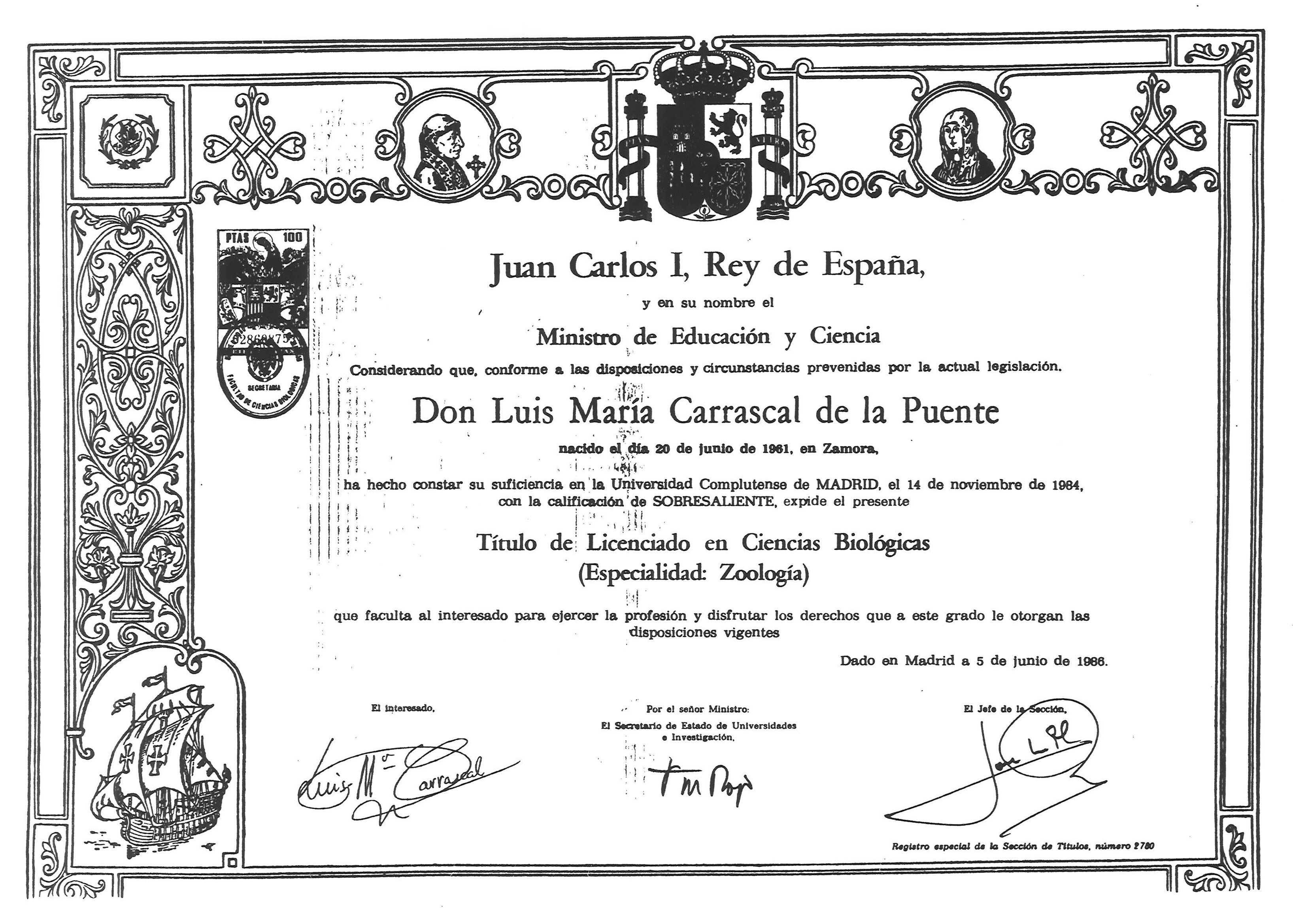
2. FORMACIÓN ACADÉMICA.
Licenciatura, Centro, Fecha (MsC)
Ciencias Biológicas, Univ.
Complutense, VIII-1984
(Sobresaliente; Director de Tesis de Licenciatura: Dr. José L. Tellería)
[Título]
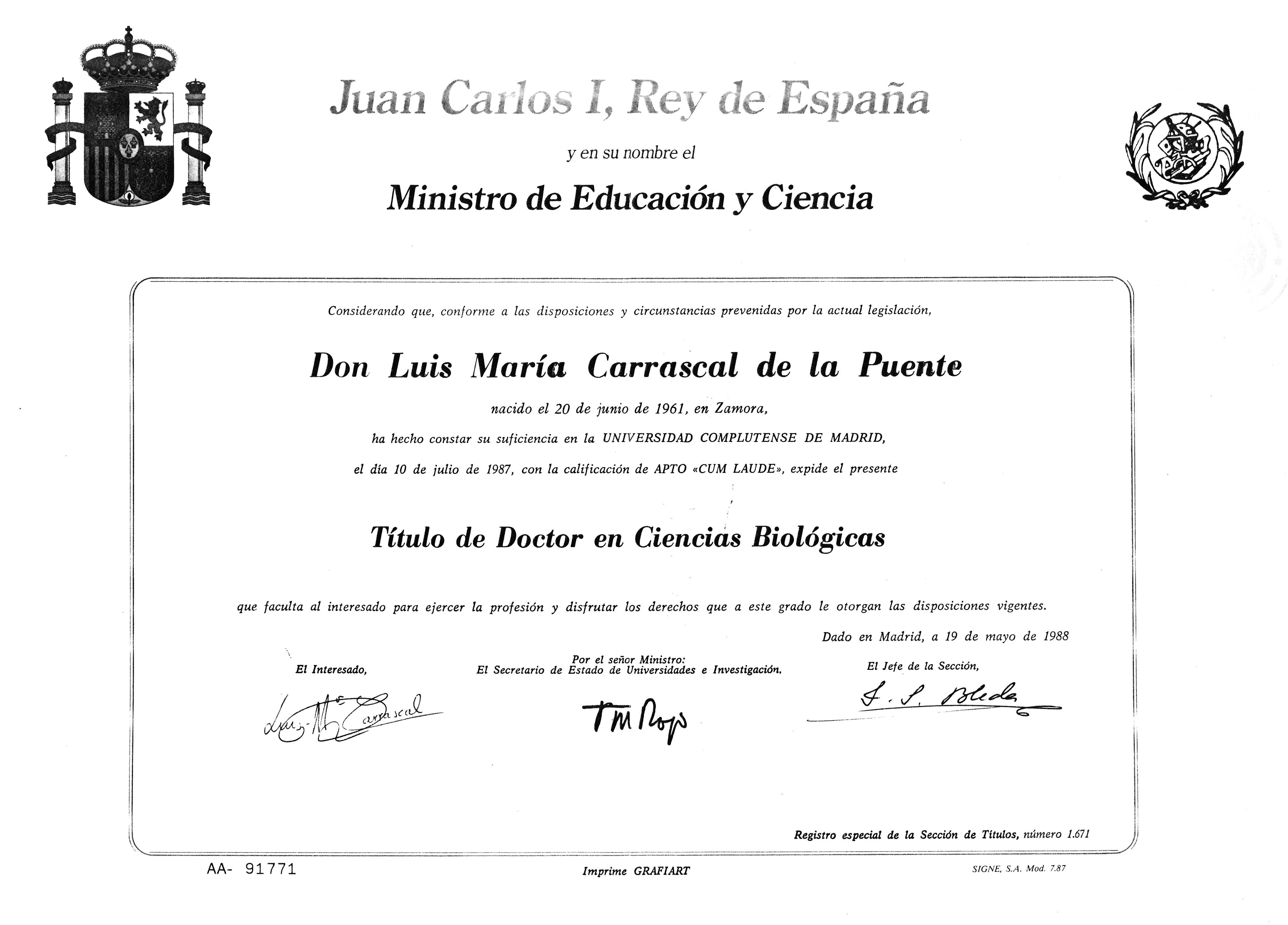
Doctorado, Centro, Fecha (PhD)
RELACIONES ENTRE AVIFAUNA Y ESTRUCTURA DE LA VEGETACIÓN EN EL PAÍS VASCO
ATLÁNTICO
[pdf] [pdf] [pdf]
[pdf] [pdf] [pdf]
[pdf] (trabajos
derivados de la Tesis Doctoral)
Zoología, Univ. Complutense, 07-VII-1987
(Apto cum laude; Director: Dr. José
L. Tellería) [Título]
3. SITUACION PROFESIONAL ACTUAL
/ PROFESSIONAL STATUS
Categoría: Profesor de Investigación / Research Professor (nivel 29 en
la escala de funcionario).
Fechas: 2007-... [reconocimiento]
Organismo: Consejo Superior de
Investigaciones Científicas.
Centro: Museo Nacional de Ciencias
Naturales.
Departamento: Ecología Evolutiva.
Dirección Postal: C/ José Gutiérrez Abascal 2, 28006 Madrid.
Teléfono: 91 5668963
Hoja de servicios: Diciembre-2018
4. Sexenios: [primero]
[segundo] [tercero] [cuarto] [quinto]
Quinquenios CSIC: seis
5. ACTIVIDADES ANTERIORES DE CARÁCTER CIENTIFICO O PROFESIONAL.
Becario Postdoctoral del CSIC.
Departamento de Vertebrados, Museo Nacional de Ciencias Naturales.
Fechas: 1988-1989.
Científico Titular CSIC.
Departamento de Ecología Evolutiva, Museo Nacional de Ciencias Naturales
Fechas: 1990-1993.
Investigador Científico CSIC.
Departamentos de Ecología Evolutiva y Biodiversidad-Biología Evolutiva, Museo
Nacional de Ciencias Naturales
Fechas: 1994-2006.
6. Adscripción Científica según UNESCO: 240106, 240102, 240120, 240116.
MAIN RESEARCH PROJECTS (1991- …)
ACTUALIZACIÓN DE LOS DATOS DE CENSO DE LAS
POBLACIONES DE HUBARA (Chlamydotis undulata fuertaventurae) EN LANZAROTE
Y FUERTEVENTURA.
Organismo financiador: GESPLAN (https://www.gesplan.es/)
Centro de ejecución: GREFA (https://www.grefa.org/) y Dept. Ecología
Evolutiva, Museo Nacional de Ciencias Naturales (CSIC).
Investigadores Principales: Fernando Garcés (GREFA) y Dr. Luis
M. Carrascal (CSIC).
Proyecto: Contrato de oferta pública GESPLAN – Gobierno de Canarias
(49.755 €).
Participación: Julio 2020 - Diciembre 2020.
TENDENCIAS POBLACIONALES EN RESPUESTA AL
CLIMA PASADO Y FUTURO: PROPUESTAS DE MITIGACIÓN PARA PREVENIR EL DECLIVE DE
AVES TERRESTRES COMUNES.
Organismo financiador: Fundación Biodiversidad, Ministerio para la
Transición Ecológica
Centro de ejecución: Departamento de Ecología, Universidad de Alcalá de
Henares.
Investigador Principal: Dra. Sara Villén-Pérez.
Proyecto: 29.340 €.
Participación: Marzo 2020 - Febrero 2022.
EFECTOS DEMOGRÁFICOS Y REMEDIACIÓN DE
ENFERMEDADES INFECCIOSAS DE ANFIBIOS EN PARQUES NACIONALES DE MONTAÑA.
Organismo financiador: Ministerio de Ciencia e Innovación
Centro de ejecución: Dept. Biogeografía y Cambio Global, Museo Nacional
de Ciencias Naturales.
Investigador Principal: Dr. Jaime Bosch.
Proyecto: P.N. 23399/17.
Participación: Noviembre 2019-Noviembre 2022.
ASESORÍA AL ESTUDIO: CUANTIFICACIÓN DEL IMPACTO QUE LOS TENDIDOS ELÉCTRICOS PROPIEDAD DE RED ELÉCTRICA DE ESPAÑA EN LAS ISLAS ORIENTALES CANARIAS TIENEN SOBRE LA MORTANDAD DE AVES.
Organismo financiador: Red Eléctrica de España,
S.A.U..
Centro de ejecución: Dept. Biogeografía y Cambio Global (Museo Nacional
de Ciencias Naturales, CSIC).
Investigador Principal: Dr. Luis M. Carrascal.
Proyecto: 11.203 euros.
Participación: Abril-2015 a Junio-2016.
ASESORÍA AL ESTUDIO: CENSO DE AVUTARDA HUBARA
(CHLAMYDOTIS UNDULATA) EN LAS ISLAS DE FUERTEVENTURA Y LANZAROTE.
Organismo financiador: Red Eléctrica de España, S.A.U..
Centro de ejecución: Dept. Biogeografía y Cambio Global, Museo Nacional
de Ciencias Naturales.
Investigador Principal: Dr. Luis M. Carrascal.
Proyecto: 7.389 euros.
Participación: Enero-2012 a Octubre-2012.
[pdf] [presentación]
INTERACCION ENTRE LA DISPONIBILIDAD DE
ALIMENTO Y EL ESTADO TERMICO DEL AMBIENTE: EFECTOS SOBRE LA DISTRIBUCION Y
BIOLOGIA DE LAS AVES INVERNANTES.
Organismo financiador: Ministerio de Ciencia e Innovación
Centro de ejecución: Dept. Biodiversidad y Biología Evolutiva, Museo Nacional
de Ciencias Naturales.
Investigador Principal: Dr. Luis M. Carrascal.
Proyecto: CGL2008-02211/BOS. (64.700 euros).
Participación: 2009-2011.
[pdf] [pdf] [pdf] [pdf] [pdf] [pdf] [pdf] [pdf] [pdf] [pdf] [pdf]
METODO DE CENSO Y ESTIMA DE POBLACIÓN DEL
PINZÓN AZUL DE GRAN CANARIA.
Organismo financiador: Consejería de Medio Ambiente de Canarias.
Centro de ejecución: Dept. Biodiversidad y Biología Evolutiva, Museo
Nacional de Ciencias Naturales.
Investigador Principal: Dr. Luis M. Carrascal.
Proyecto: 12.000 euros.
Participación: Febrero-2008 a Octubre-2008.
[informe] [presentación]
FUNDAMENTOS ECOLOGICOS Y BIOGEOGRAFICOS DE LA
RAREZA DE LA AVIFAUNA TERRESTRE CANARIAS. Revisión del catalogo regional de
especies amenazadas.
Organismo financiador: Consejería de Medio Ambiente de Canarias.
Centro de ejecución: Dept. Biodiversidad y Biología Evolutiva, Museo
Nacional de Ciencias Naturales.
Investigador Principal: Dr. Luis M. Carrascal.
Proyecto: 12.000 euros.
Participación: Septiembre-2006 a Septiembre-2007.
[pdf]
[pdf] [pdf] [pdf]
[informe] [presentación]
FACTORES DETERMINANTES DE LA DISTRIBUCIÓN Y
ABUNDANCIA DE AVES: DEL USO DEL ESPACIO Y LAS PREFERENCIAS DE HÁBITAT A LA
BIOGEOGRAFÍA ECOLÓGICA.
Organismo financiador: Dirección General de Investigación
Científica. Programa Nacional de Promoción General del Conocimiento. Ministerio
de Educación y Ciencia.
Centro de ejecución: Dept. Biodiversidad y Biología Evolutiva, Museo
Nacional de Ciencias Naturales.
Investigador Principal: Dr. Luis M. Carrascal.
Proyecto: CGL2005-02642/BOS. (36.771 euros).
Participación: Octubre de 2005 a Octubre de 2008.
[pdf] [pdf] [pdf] [pdf] [pdf] [pdf]
[pdf] [pdf] [pdf] [pdf] [pdf] [pdf] [pdf] [pdf]
AVES ESTEPÁRICAS EN LAS ISLAS ORIENTALES DEL
ARCHIPIÉLAGO CANARIO.
Organismo financiador: Consejería de Medio Ambiente de Canarias.
Centro de ejecución: Dept. Biodiversidad y Biología Evolutiva, Museo
Nacional de Ciencias Naturales.
Investigador Principal: Dr. Luis M. Carrascal (Javier Seoane,
David Palomino, César Luis Alonso)
Proyecto: 3 proyectos de 12.000 euros.
Participación: Enero-2005 a Junio-2005.
[pdf] [pdf] [pdf] [pdf] [pdf] [pdf] [pdf]
[pdf] [informe
1] [informe
2] [informe
3]
FACTORES DETERMINANTES DE LA BIODIVERSIDAD EN
LA COMUNIDAD DE MADRID Y PREDICCIÓN DE SU VARIACIÓN GEOGRÁFICA.
Organismo financiador: Consejería de Educación de la Comunidad de
Madrid.
Centro de ejecución: Dept. Biodiversidad y Biología Evolutiva, Museo
Nacional de Ciencias Naturales.
Investigador Principal: Dr. Jorge M. Lobo.
Proyecto: 07M/0080/2002 (8.050 euros)
Participación: Enero de 2003 a diciembre de 2004.
[pdf] [pdf] [pdf] [pdf] [pdf] [pdf]
FACTORES DETERMINANTES DE LA DISTRIBUCIÓN Y
ABUNDANCIA INVERNAL DE PASSERIFORMES.
Organismo financiador: Dirección General de Investigación
Científica. Programa Nacional de Promoción General del Conocimiento. Ministerio
de Ciencia y Tecnología.
Centro de ejecución: Dept. Ecología Evolutiva, Museo Nacional de
Ciencias Naturales.
Investigador Principal: Dr. Luis M. Carrascal.
Proyecto: BOS2000-0993. (2.350.000 pts)
Participación: Diciembre-2000 a Diciembre-2003.
[pdf] [pdf] [pdf] [pdf] [pdf] [pdf] [pdf] [pdf]
[pdf] [pdf]
[pdf]
LAS POBLACIONES DE AVES COMO INDICADORES DEL
ESTADO DE CONSERVACIÓN Y REGENERACIÓN DE LOS BOSQUES CADUCIFOLIOS DE LA
COMUNIDAD AUTONOMA DE MADRID.
Organismo financiador: Dirección General de Enseñanza superior e
Investigación Científica. Comunidad Autónoma de Madrid.
Centro de ejecución: Dept. Ecología Evolutiva, Museo Nacional de
Ciencias Naturales.
Investigador Principal: Dr. Luis M. Carrascal.
Proyecto: 07M/0137/2000 (9.680.000 pts).
Participación: Enero-2001 a Diciembre-2002.
[pdf] [pdf] [pdf] [pdf] [pdf] [pdf]
[pdf]
BIOLOGÍA INVERNAL DE PASSERIFORMES FORESTALES. ANÁLISIS DE LA
CONDUCTA, SUPERVIVENCIA Y CONDICIÓN FÍSICA.
Organismo financiador: Dirección General de Investigación Científica
y Técnica.
Centro de ejecución: Dept. Ecología Evolutiva, Museo Nacional de
Ciencias Naturales.
Investigador Principal: Dr. Luis M. Carrascal.
Proyecto: PB95-0102-C02-01. (4.510.000 pts para el subproyecto PB95-0102-C02-01).
Participación: Noviembre-1996 a Noviembre-1999.
[pdf] [pdf] [pdf]
[pdf] [pdf] [pdf] [pdf]
MORFOLOGÍA, OBTENCIÓN DE ALIMENTO,
ORGANIZACIÓN SOCIAL, CONDICIÓN FÍSICA Y DEMOGRAFÍA DE PASSERIFORMES. UN ESTUDIO
INTEGRADO SOBRE COMO SOBREVIVIR AL INVIERNO.
Organismo financiador: Dirección General de Investigación Científica
y Técnica.
Centro de ejecución: Dept. Ecología Evolutiva, Museo Nacional de
Ciencias Naturales.
Investigador Principal: Dr. Luis M. Carrascal.
Proyecto: PB92-0044. (3.157.000 pts para el subproyecto
PB92-0044-C02-01).
Participación: Julio-1993 a Julio-1996.
[pdf]
[pdf] [pdf] [pdf] [pdf] [pdf] [pdf] [pdf]
ESTRATEGIAS REPRODUCTIVAS EN PINGÜINOS
ANTÁRTICOS.
Organismo financiador: Comisión Interministerial de Ciencia y
Tecnología.
Centro de ejecución: Dept. Ecología Evolutiva, Museo Nacional de
Ciencias Naturales, Madrid.
Investigador Principal: Dr. Juan Moreno.
Proyecto: ANT91-1264. (26.000.000 pts).
Participación: Agosto de 1991 a Agosto de 1994.
ECOLOGÍA INVERNAL DE PASSERIFORMES EN AMBIENTES FORESTALES
MEDITERRÁNEOS.
Organismo financiador: Consejería de Educación de la Comunidad de
Madrid.
Centro de ejecución: Dept. Ecología Evolutiva, Museo Nacional de
Ciencias Naturales, Madrid.
Investigador Principal: Dr. Luis M. Carrascal.
Proyecto: C176/91. (2.600.000 pts + 500.000 pts en la prórroga).
Participación: Septiembre-1991 a Septiembre-1993 (prórroga de Sept.-1993
a Sept.-1994).
Luis
M. CARRASCAL
Profesor de
Investigación
Dept. Ecología Evolutiva
Museo Nacional de Ciencias
Naturales
Consejo Superior de Investigaciones
Científicas
C/ José Gutiérrez Abascal, 2. 28006 Madrid. SPAIN
Tfno: 34 91 5668963 - Fax: 91
5668960
Localización
del despacho (B)
en Google Maps
Email: mcnc152[at]mncn.csic.es
Luis M. CARRASCAL
Profesor de
Investigación
Dept.
Biogeografía y Cambio Global
Museo Nacional de Ciencias
Naturales
Consejo Superior de Investigaciones
Científicas
I am a research professor at the Department of Evolutionary Ecology at the Museo Nacional de Ciencias Naturales (Spain). My current research interests are focused on the causal explanations of elevational patterns in species distribution, and on the interspecific variation in position and breadth of organisms within thermal gradients. We are interested in obtaining “good quality” data on species abundance and richness, species-habitat relationships, and across-species variation in population trends in a scenario of climate warming and landscape changes. We will focus on abiotic and physiologically based functional explanations to the relationship with the environment, and on the importance of species interactions in leading to spatial segregation of species into distinct ranges. Another important goal is the study of intra- and inter-population plasticity in the thermal response, and their capacity to acclimate when they are subjected to contrasting thermal conditions that are present within their ranges of distribution. Our observational and experimental scenario is located in a wide geographic region of Northern and Central Spain, as well as throughout two broad altitudinal gradients in the Canary islands. We use montane and alpine birds and beetles as study models. This research project, by linking spatial mechanisms and temporal patterns of range shifts, should increase our knowledge on the ability of species to track "optimal conditions", and on the responses of ecological communities to climate change.
Luis M. Carrascal es profesor de investigación del CSIC en el Dept. de Ecología Evolutiva del Museo Nacional de Ciencias Naturales (Madrid). Desde hace 30 años sus intereses científicos se han centrado en el análisis de los patrones de distribución-abundancia de vertebrados terrestres, tanto desde una perspectiva extensiva biogeográfica y macroecológica, como desde una aproximación funcional autoecológica que incluye aspectos ecomorfológicos, de búsqueda de alimento, riesgo de depredación, preferencias de hábitat, interacción con el estado térmico del ambiente y sus repercusiones sobre la condición física de los individuos. También ha desarrollado una actividad de investigación orientada a la conservación de la biodiversidad animal, el análisis de los impactos humanos sobre ella (principalmente urbanismo) y el establecimiento de criterios que definen la propensión a tener problemas de conservación (más detalles). Es autor de más de 100 trabajos científicos sobre estos aspectos, y ha dedicado una considerable parte de su tiempo a la formación académica especializada (método científico y herramientas estadísticas en Ciencias Naturales) y a la divulgación científica sobre la historia natural de vertebrados terrestres españoles.